- May 9
PSLE Oral: Step by step guide on how to add your personal experiences
- Jemmies Siew
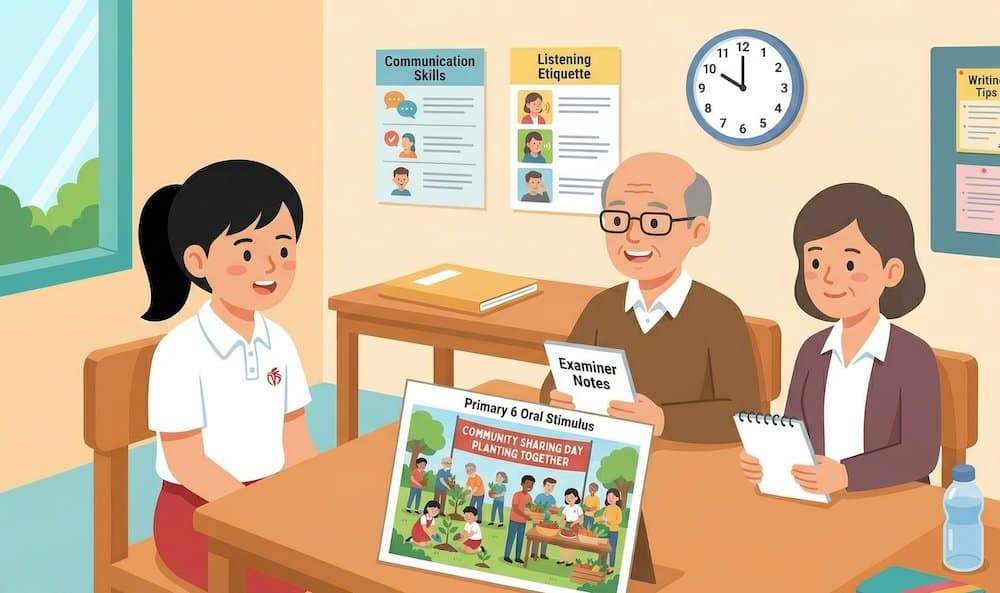
One of the fastest ways to lose marks in the PSLE Stimulus-Based Conversation is to give a one-sentence answer. “Yes, I have done that before.” Full stop. Silence. The examiner waits. The student stares at the photograph. The moment passes, and so do the marks.
The SBC is worth 25 out of 40 oral marks, and the questions almost always move from the photograph to the student’s own life. “Have you ever done something like this?” “Would you enjoy this activity? Why?” “Tell me about a time you helped someone.” These questions are invitations to share real, specific experiences, and the students who do it well are the ones who score in the higher bands.
The good news is that sharing personal experiences in a structured, vivid way is a skill that can be practised and improved. It does not require dramatic stories or perfect English. It requires a simple structure, a few concrete details, and the confidence to talk about ordinary moments in a way that sounds genuine. This guide breaks the process into five clear steps your child can start using today.
Where Personal Experience Fits in the SBC
During the Stimulus-Based Conversation, the examiner typically asks two to three questions. The first question is always based directly on the photograph. The second and third questions branch outward, asking the student to draw on their own experiences, share opinions, or reflect on a related topic.
It is these second and third questions where personal experience becomes essential. A student who can only describe the photograph but cannot connect it to their own life will struggle to fill the expected speaking time and will miss the elaboration that examiners reward. The marking criteria assess two things: the ability to express ideas and opinions clearly, and the ability to speak fluently with accurate grammar and appropriate vocabulary. Personal experiences address both, because they give the student something real and specific to talk about, which naturally produces longer, more fluent answers.
For a full breakdown of the types of SBC questions that appear each year, visit our PSLE Oral Topics: A 2025 Guide.
Step 1 – Build an Experience Bank Before the Exam
Students only have a few seconds to think once the examiner asks a question, so they need a ready-made mental library of everyday experiences they can draw from. These do not need to be extraordinary. Ordinary moments described well are far more effective than vague references to dramatic events.
Four Categories to Prepare
School: CCA activities, class projects, Sports Day, Teachers’ Day celebrations, recycling drives, school camps.
Family: cooking together, weekend outings, visiting grandparents, helping with household chores, family traditions.
Community: neighbourhood clean-ups, library visits, community events, helping a neighbour, volunteering at a charity drive.
Personal habits: reading, exercising, learning a new skill, managing screen time, trying a new food.
For each category, your child should prepare one or two short, specific memories with enough detail to talk about for 30 to 45 seconds. The goal is not to memorise scripts but to have a reservoir of real experiences that can be matched to almost any SBC question.
Matching an Experience to a Question
When the examiner asks a question, your child should quickly identify which category it falls into and select the closest experience from their bank.
For example, if the photograph shows families at an outdoor event and the examiner asks, “Have you ever taken part in a community activity?”, a student with a prepared experience bank might think: community category, neighbourhood food donation drive last December. That match takes two seconds instead of twenty, which means more time for a well-structured answer.
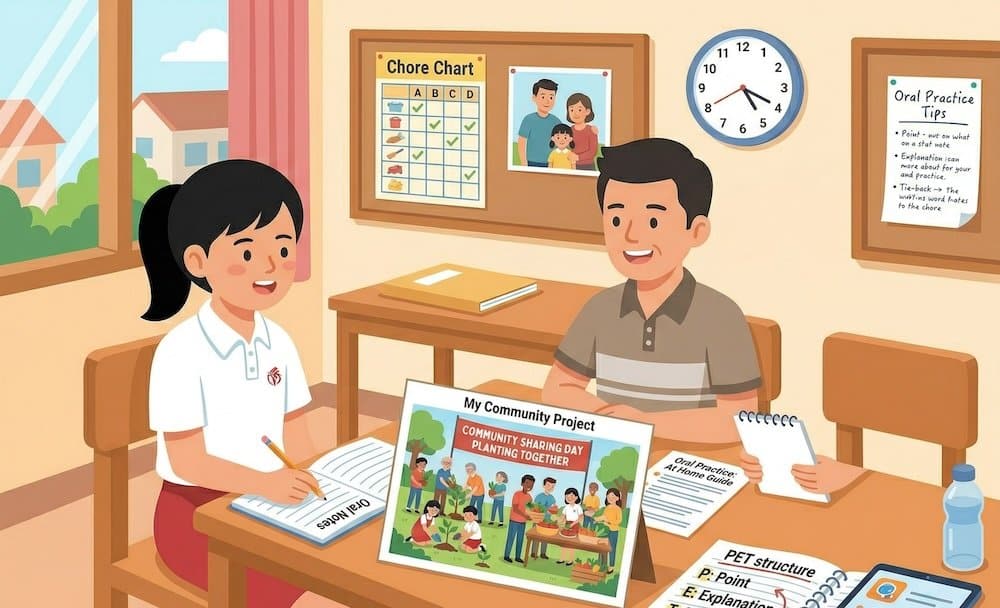
Step 2 – Structure Your Answer With PET
A common problem is that students share experiences as a jumble of disconnected details, or they start strong and then trail off without making a point. A simple structure keeps the answer focused and complete.
PET stands for Point, Experience, Thought.
Point: Answer the question directly in one sentence. Do not hedge or waffle.
Experience: Share a brief, specific anecdote with key details (who, where, when, what happened).
Thought: End with how you felt, what you learned, or why it mattered.
PET in Action
Question: “The photograph shows students planting trees in a school garden. Have you taken part in something similar?”
Point: “Yes, I helped with a gardening project at my school two years ago.”
Experience: “My class was put in charge of growing chilli plants in a small plot beside the canteen. Every Friday after recess, a group of us would water the plants, pull out weeds, and check whether the soil was dry. I remember the first few weeks felt tedious because nothing seemed to be growing, but after about a month, we spotted tiny green shoots appearing, and everyone started competing to see whose row would produce chillies first.”
Thought: “I felt really satisfied when we finally harvested enough chillies for the canteen aunties to use in their cooking. It taught me that looking after something takes patience, and that even small efforts add up over time.”
This answer takes roughly 40 seconds to speak, hits every PET element, and sounds natural because it is built from a real, specific memory.
Step 3 – Add Vivid Details With 5W1H
The difference between a thin answer and a convincing one is almost always detail. But students often either include too little (“I helped my grandmother once”) or ramble too much and lose the examiner. The 5W1H checklist keeps details specific without letting the answer run too long.
Who: You and one or two other key people (a friend, a parent, a teacher).
Where: A clear, specific place (the school hall, the void deck, Pasir Ris Park).
When: A simple time marker (during the June holidays, last Chinese New Year, on a Saturday morning).
What: One or two main actions (what you actually did).
Why: The reason it happened (the school organised it, your mother suggested it).
How you felt: One or two emotions or thoughts.
Thin vs Detailed
Question: “Have you ever helped someone carry something heavy?”
Thin: “Yes, I helped my grandfather carry shopping bags once. It was tiring but I was happy.”
Detailed: “Yes. Last Chinese New Year, I helped my grandfather carry bags of mandarin oranges and snacks home from the NTUC near our block. He had bought so many things that the plastic bags were cutting into his fingers. I took the two heaviest bags and walked slowly beside him because he needed to rest at every bench. By the time we reached the lift, my arms were aching, but he patted my shoulder and said, ‘Good boy, strong boy,’ which made me smile the whole way up.”
The detailed version uses roughly 15 extra seconds of speaking time but creates a vivid scene the examiner can picture. Notice it stays under a minute and does not wander off topic.
Step 4 – Show Feelings and Lessons Clearly
Many students describe what happened but stop before explaining how they felt or why it mattered. This is where higher-band answers separate themselves from average ones. Examiners reward reflection because it shows maturity and the ability to think beyond the surface level of a question.
A Simple Formula
After describing the experience, add three short elements:
Feeling: “I felt nervous / proud / relieved / grateful.”
Reason: “Because…” (link to something specific in the story).
Lesson or change: “After that, I…” or “It taught me that…”
Applied Example
Question: “Have you ever been to a camp? How did you feel about it?”
Experience: “Yes, I attended a three-day adventure camp at a site near Pulau Ubin during the September holidays last year. One of the activities was a high ropes course, and I was terrified because I have always been uncomfortable with heights. My legs were shaking on the platform, and I almost told the instructor I wanted to come down. But my teammates kept calling out encouragement from below, and the instructor told me to focus on one step at a time instead of looking down.”
Feeling, reason, lesson: “I felt incredible when I finally reached the other end, because five minutes earlier I had genuinely wanted to quit. That experience taught me that fear does not always mean I cannot do something. It just means I need to take it slowly and trust the people around me.”
This kind of explicit reflection is exactly what oral coaches recommend. It turns a simple anecdote into a response that demonstrates both fluency and depth of thinking. For more strategies on building speaking confidence, see our 10 Tips to Boost Your Speaking Confidence.
Step 5 – Link Back to the Photograph
The strongest SBC answers do not just share a personal story and stop. They close the loop by connecting the experience back to the photograph or topic, showing the examiner that the response is relevant and considered.
Linking Phrases Your Child Can Use
“This reminds me of what I see in the photograph, because…”
“Like the people in the picture, I also…”
“That experience is similar to what is happening here, since…”
“So when I look at this photograph, I can understand how they must be feeling.”
Full Example With Link-Back
Photograph: A family cycling together in a park.Question: “Would you enjoy an activity like this with your family?”
Answer: “Yes, I think I would enjoy it very much. During the last December holidays, my parents rented bicycles for my brother and me at Coney Island. I was wobbly at first and kept veering to the left, so my mother cycled right beside me and kept saying, ‘Steady, steady.’ By the end of the morning, I could ride on my own without anyone holding the seat. I felt proud because it was one of those things I had always been nervous about trying.”
Link-back: “So when I look at this photograph, I can imagine how happy the family feels riding together. It reminds me of that morning with my own family, and how something as simple as cycling can bring everyone closer.”
That final sentence explicitly ties the personal experience to the stimulus. It takes five seconds to say and makes the entire answer feel complete and purposeful.
Delivery Tips – Sound Natural, Not Memorised
Examiners can tell immediately when a student is reciting a rehearsed script that does not match the actual question. What they want to hear is a natural, fluent response that sounds like a genuine conversation, even if the English is not perfect.
Use “I” confidently. “I did…”, “I felt…”, “I learned…” sounds more sincere than vague generalisations like “People usually…” or “Everyone should…”
Vary your tone. Sound excited when describing a fun memory, more serious when talking about a difficult moment. A flat monotone makes even a good answer sound rehearsed.
Pause instead of filling. A brief, natural pause while thinking is far better than a string of “um”, “uh”, “like”, “you know.” The examiner will wait.
Keep it to 30 to 45 seconds per answer. A well-structured PET response with 5W1H details and a reflection naturally fills this time without running too long.
The best practice method is the simplest one. At dinner each evening, ask your child one open-ended question about their day and encourage them to answer in at least four to five sentences, using the PET structure. Over weeks, this builds the habit of spoken elaboration that no amount of last-minute cramming can replicate. For more on preparing for the oral exam as it approaches, read our guide on Preparing for PSLE Oral.
Practice With Real SBC Topics
The experience bank your child builds is only useful if they practise matching it to real questions. Take a past PSLE photograph prompt, set a timer, and have your child answer three questions using the five steps above. Record the answers and listen back together, checking for structure (PET), detail (5W1H), reflection (feeling, reason, lesson), and the link-back to the photograph.
Common SBC themes that appear regularly include family activities, school events, helping others, food and hawker culture, the environment, health and fitness, friendships, and community life. Students who have thought about these themes in advance and prepared one or two go-to experiences for each will find it far easier to respond naturally on exam day.
For a collection of past oral questions to practise with, visit our Past Years PSLE Oral Questions page. For a full guide to the themes and how they are tested, see our PSLE Oral Topics: A 2025 Guide.
Building a wider vocabulary also helps your child express experiences more vividly. Instead of repeating “happy” and “sad”, having access to words like “relieved”, “grateful”, “frustrated”, or “determined” makes answers sound more precise and mature. For practical strategies, explore our guides on How to Improve Vocabulary to Prepare for PSLE and Fun Ways to Improve Your Child’s Vocabulary.
At WRITERS AT WORK, our oral programme prepares students for every SBC question type with structured practice, personalised feedback, and a wide bank of photograph prompts covering the most commonly tested themes. Students learn to share personal experiences naturally using the PET framework, build confidence through regular mock exams, and develop the fluency that examiners reward. Explore our programmes and give your child the tools to speak clearly and score well. For more powerful tips on every component of the oral exam, see our guide on Unlocking Success: Powerful PSLE Oral Tips.
Follow us on Facebook and Instagram for weekly oral practice tips and resources.
Frequently Asked Questions
Do personal experiences need to be true?
They should be based on real events whenever possible. Examiners can tell when a story sounds fabricated because it tends to be vague and lacks sensory detail. However, it is perfectly fine to adjust small details (exact dates, names) for convenience. The key is that the experience sounds genuine and specific.
What if my child cannot think of a relevant experience during the exam?
This is exactly why the experience bank matters. If your child has prepared one or two memories for each common theme (school, family, community, personal habits), they will almost always have something relevant to draw from. If nothing fits perfectly, they can share a related experience and acknowledge the connection: “I have not done exactly this, but something similar happened when…”
How long should a personal experience answer be?
Aim for 30 to 45 seconds of speaking time. This usually translates to about four to six sentences: one for the point, two to three for the experience with details, and one to two for feelings and reflection. Answers shorter than 20 seconds tend to be too thin, while answers longer than a minute risk losing focus.
Should my child use the PET structure for every SBC question?
PET works best for questions that ask about past experiences. For pure opinion questions (“Do you think…?”), a simpler structure of Opinion, Reason, Example works well, where the example can still be a personal experience. The underlying principle is the same: state your answer, support it, and reflect on it.

Article Written By
Agnes Ng
Agnes Ng, Co-Founder and Teaching & Curriculum Director of WRITERS AT WORK. An NUS Honours graduate and published author with over 30 years of experience, Agnes has been the architect of the organization’s student-centric curricula since 2012.
Dedicated to teacher mentorship and academic excellence, she has guided hundreds of students to achieve outstanding results. Her expertise and commitment to high-quality education remain the cornerstone of WRITERS AT WORK’s success in empowering every learner.