- Apr 25
O-Level Situational Writing: Crafting a Speech
- Jemmies Siew
How often do you listen to speeches as a student? Do you usually remember what was said, or does it go in one ear and out the other? That gap between a speech that sticks and one that does not comes down to how well it was written. For Situational Writing, a good speech is one that speaks directly to the audience and hits every task requirement along the way.
In this guide, we break down what a speech is and how to craft it so you can score well.
What is a Speech?
A speech is a piece of writing meant to be delivered out loud to an audience. The person delivering it is standing in front of a crowd, trying to connect with them, hold their attention, and leave them with something to think about.
In the context of O-Level Situational Writing, the speech task usually places you in a specific role. You might be a student representative addressing your school during an assembly, a member of a club presenting a proposal to teachers and peers, or a young leader speaking at a community event. The question will set the scene and give you bullet points to cover.
The Format and Structure of a Speech
One thing students appreciate about speeches is that they are more flexible than emails or letters. There is no strict header to fill in and no fixed sign-offs to memorise. That said, structure still matters.
1. Salutation
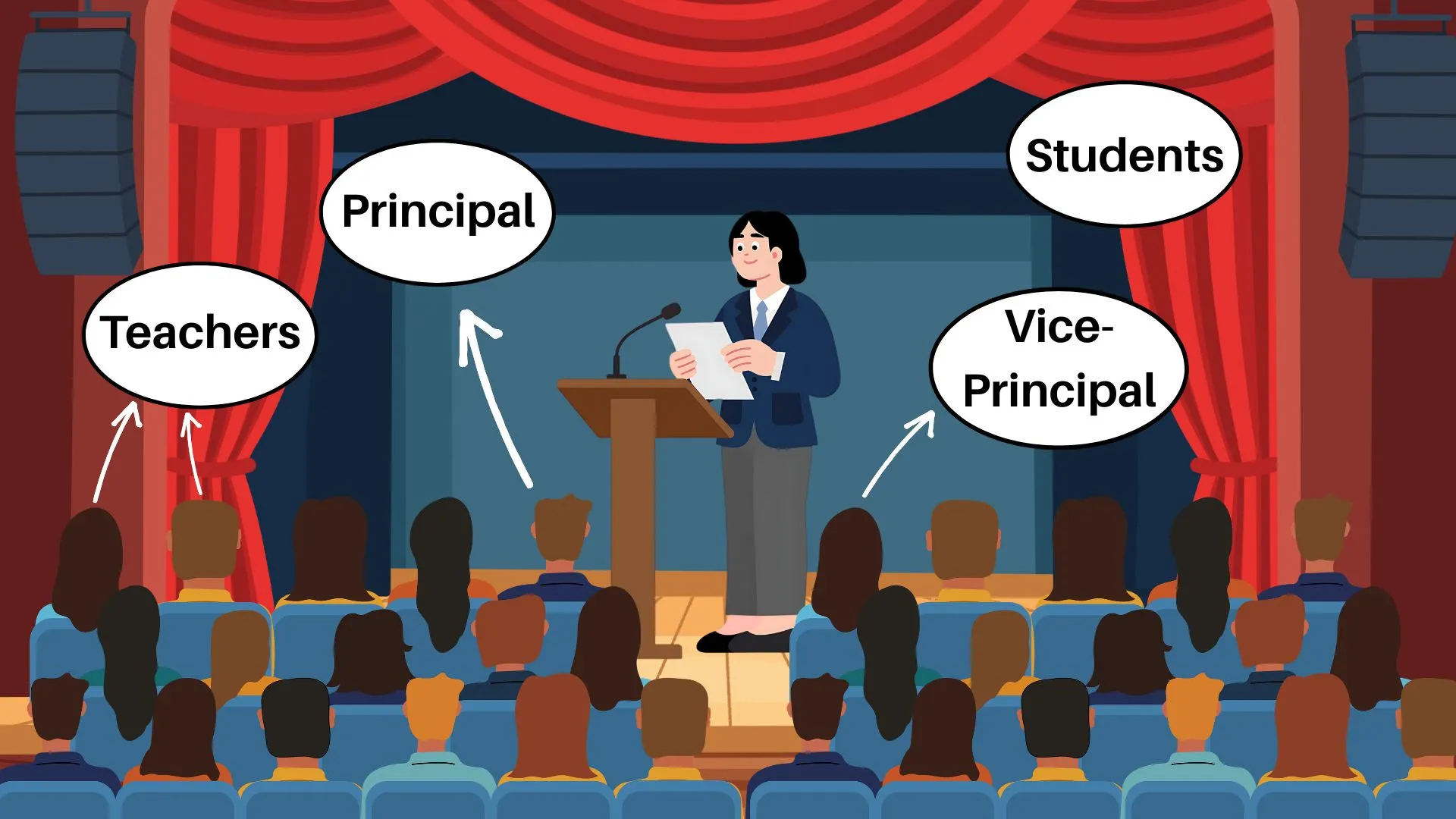
Every speech opens with a greeting to the audience. This is not optional! It is the first thing the examiner checks, and skipping it is a format error that costs you marks.
Your salutation should acknowledge the people who are listening to your speech, starting with the most senior and working your way down. Keep it realistic based on the scenario given in the question.
Example:
Good morning, Principal Tan, teachers, and fellow students.
2. Introduction
Once you have greeted your audience, continue in the same paragraph. Tell the audience your name and your role, provide brief context, and clearly state the purpose of your speech.
Here is a model introduction:
Good morning Principal, VPs, HODs and teachers, [salutation] I am John, the President of the Student Council [name + role]. A recent survey revealed that the student population in WOW High School is suffering from low levels of school pride [context]. The Student Council sees this as a serious issue because school pride has a direct impact on students’ school life experience as well as their academic achievements, CCA commitments and sense of belonging [context]. To raise the level of school pride, my committee is proposing to organise visits to the school’s heritage gallery [purpose]. We believe this initiative will encourage students to stand tall and proud as WOW High Schoolers. [purpose/concluding sentence]
3. Develop Your Points
The body of your speech is where you address the bullet points from the question. Give each bullet point its own paragraph and develop it with details, reasons, and examples. A useful approach is to follow the PEEL structure: make your Point, provide Evidence or an Example, Explain how it supports your point, and Link back to your overall purpose. Remember to use your own words as much as possible.
The bullet points will change depending on the question, but some common ones include:
• the reasons for your choice of activity or event
• how the activity or event would be organised
• how students stand to benefit
Here is an example body paragraph that addresses the bullet point on reasons for the choice of activity, continuing from the introduction above:
Firstly, we will revamp the heritage gallery to include more significant exhibits from our alumni and introduce interactive activities to make the exhibits more relevant for current and future cohorts. We need all hands on deck to introduce new, economical exhibits and activities for the gallery. My committee will do our best to make this a meaningful and interesting experience for everyone involved. Currently, the heritage gallery features photos and awards from games and youth festivals that our students have participated in throughout the years. Also, the gallery walls are filled with newspaper clippings that feature our students’ achievements. We feel that we should update the features by involving the Journalism & Photography Club to share write-ups and photos from more recent events.
A few things to keep in mind as you write the body:
• Use signposting language to guide your audience through your speech. Phrases like “First and foremost”, “Moving on to”, “Another important point to consider” and “Finally” help listeners follow your train of thought.
• Write in a spoken register. This means your sentences can vary in length. Short sentences can be used for strong impact. Longer ones can be used to build momentum and context.
• Address the audience directly. Use “you” and “we” to create a sense of shared experience.
• Match your tone to the question. The question will usually give you clear signals about what tone to use. For example, a speech to fellow students about a school event can be warm and enthusiastic. There might be other occasions where a formal tone is required.
• Be persuasive where the task calls for it. If you are encouraging the audience to take action or support an idea, you can try to build your case with conviction. Do this by using phrases that signal confidence such as “I firmly believe” or “There is no doubt that”.
4. Conclusion
A speech without a proper conclusion feels unfinished. Your conclusion should bring everything together. Summarise the key message of your speech, leave the audience with something that resonates, and where appropriate, include a call to action. Phrases like “I hope you will consider…”, “I urge you to…” or “Together, we can…” work well here. And of course, always thank your audience at the end.
Model conclusion:
I believe that we will graduate from WOW High School with our heads held high and our hearts filled with pride. As the student council president, I promise that the committee will take the initiative to plant a seed of pride and let it blossom. We aim to make the gallery a representative feature of our school, one that will make all current students and future first-year students feel honoured to belong here. Our WOW heritage gallery will be a place filled with our legacy. I trust that with your support, the heritage gallery will be an impactful success for everyone. Thank you.
Your Path to Speech Writing Success
You have come to the end of our guide. We hope it has been useful. Writing a speech for Situational Writing is something every student can do well with the right preparation. Follow the structure, develop each bullet point fully, and write with your audience in mind. Do that, and you are already most of the way there!
At WRITERS AT WORK, our Comprehensive English Programme gives students structured, guided practice across every Situational Writing format, including speeches, formal and informal emails, reports, and more. Our experienced teachers provide detailed, personalised feedback on every piece so you know exactly what to improve and how. If you want to walk into your O-Level exam feeling prepared and confident, join us today!

Mastering the O Level English paper requires a blend of creative strategy and technical precision. At WRITERS AT WORK, our Secondary English tuition in Singapore provides the focused environment students need to excel. Whether you are struggling with essay writing topics in English or looking for good hooks for essay introductions, our curriculum offers the frameworks for success. If you are still deciding between O-Level or Integrated Programme (IP), we can also help you navigate the best path for your child’s academic future.
Frequently Asked Questions (FAQs)
Qn. 1.Do I always need a salutation in a speech?
Yes. The salutation is part of the format, and leaving it out will cost you marks. Always greet your audience at the start of your speech. Base your salutation on the context given in the question so it feels appropriate to the occasion.
Qn. 2. Do I need to memorise speech phrases before the exam?
You do not need to memorise anything word for word, but having a bank of useful phrases in your head makes the writing process much faster and more confident. Knowing how to open strongly, how to transition between points, and how to close with impact means you can focus your energy on developing the content rather than figuring out how to structure it.
Qn. 3. What happens if I miss out a bullet point?
Missing a bullet point is likely to cost you content marks. Make sure you address all the given points clearly and develop each one with sufficient detail.
Qn. 4. Do I always need a call to action in my speech?
Not always, but it is highly recommended when the task involves persuading your audience. A call to action makes your speech more purposeful and impactful.

Article Written By
Agnes Ng
Agnes Ng, Co-Founder and Teaching & Curriculum Director of WRITERS AT WORK. An NUS Honours graduate and published author with over 30 years of experience, Agnes has been the architect of the organization’s student-centric curricula since 2012.
Dedicated to teacher mentorship and academic excellence, she has guided hundreds of students to achieve outstanding results. Her expertise and commitment to high-quality education remain the cornerstone of WRITERS AT WORK’s success in empowering every learner.