- Jul 31
PSLE Oral Topics: Road Safety & Public Behaviour
- Jemmies Siew
Road safety and public behaviour are some of the most reliable conversation topics in the PSLE Oral examination. They sit firmly inside the “common occurrences that students experience in daily life” that SEAB uses to guide topic selection, and they give every child something concrete to talk about: a zebra crossing outside their school, an MRT ride home, a hawker centre lunch. Past PSLE oral questions in circulation have asked students how they practise road safety, what their favourite mode of transport is and why, and how schools could do more to keep them safe on the roads.
From the 2025 sitting onward, the PSLE Oral is worth 40 marks (20 per cent of the overall English grade), with 25 of those marks allocated to the Stimulus-Based Conversation (SBC). The stimulus is a real-life photograph, and your child will be asked three questions: one anchored in the photograph, and two broader questions on personal experience and opinion. You can read more in our guide to the 2025 oral changes.
This post breaks the topic into three connected themes, with talking points, vocabulary, sample answer starters, common mistakes and a parent-practice table you can use at home this week.
Why This Topic Matters for PSLE Oral
The SBC rewards children who can observe carefully and form a clear opinion, backed up by personal experience. Road safety and public behaviour invite all of those skills. A child who has practised this topic well can describe a zebra-crossing scene, then weigh up whether Singaporeans queue gracefully enough at the bus stop.
It is also a topic where the examiner can tell almost immediately whether the child is speaking from real experience. Every Primary 6 student in Singapore has crossed a road outside a school. Every child who takes public transport has stood near a yellow priority seat. The specifics are within reach if a child has thought about them ahead of time.
For more topic ideas across the syllabus, see our PSLE Oral Topics 2025 Guide.
The Three Themes Covered in This Blog
The blog is organised around three connected themes:
Road Safety
Public Transport Etiquette
Being Considerate in Public Places
Each theme below uses the same structure: what it covers, possible photo stimuli, likely question angles, three speaking points, useful vocabulary and a sample answer starter.
Theme 1 – Road Safety
A. What This Theme Is About
Road safety is about staying alert and predictable on the road, whether your child is walking to school or cycling to the MRT. The Singapore Road Safety Council’s message for children is straightforward: cross at designated crossings, wait for the green man, and look both ways carefully before stepping off the kerb. A recent change worth knowing is that from 1 July 2025, the Land Transport Authority began enforcing new Pedestrian-Only Paths, with bicycles and kick-scooters no longer allowed on them. A child who can name this rule sounds informed and current.
B. What Students May See in a Photo Stimulus
Realistic scenes include:
Primary school students at a zebra crossing outside a school gate, one holding a handheld “STOP” sign as part of the 2025 pilot
A teenager with earphones in and eyes on a phone stepping off a kerb, with a parent reaching to grab their arm
Children at the Road Safety Community Park at East Coast Park, navigating a miniature junction with traffic lights
A clearly marked sheltered walkway with “Pedestrians Only” on one side and a cycling lane on the other
The photograph is the springboard for the first question. Your child should describe what they see first, then infer the mood of the people in the scene before drifting into personal opinion.
C. Possible PSLE Oral Question Angles
Q1 asks the child to observe and infer; Q2 and Q3 broaden out. Examples:
What do you think the students in the photograph are doing? How might they be feeling?
How do you cross the road near your school? Do you always follow the rules?
Do you think it is dangerous for people to use their phones while crossing the road?
Are children today more careful on the roads than they used to be?
D. Simple Speaking Points for Students
Point 1: Stop. Look. Cross. The Singapore Road Safety Council’s three-step drill is still the heart of road safety. Even when the green man is showing, drivers occasionally beat the red light. Looking carefully in both directions before stepping off the kerb gives a few extra seconds to spot a car that is not slowing down.
Point 2: Distracted walking is a real danger. Phones and group chatter reduce what a student notices at a crossing. A simple habit such as pocketing the phone while crossing the road removes most of the risk.
Point 3: Singapore has invested in road safety education for decades. The Road Safety Community Park at East Coast Park has trained primary school students since the 1980s, and Singapore Road Safety Month runs every year. Children who have been there can describe what they learned, which always sounds authentic to the examiner.
E. Useful Vocabulary and Phrases
cross at designated crossings
wait for the green man
Stop. Look. Cross.
an overhead bridge
a zebra crossing
stay alert at all times
distracted walking
pedestrian-only paths
be a careful road user
road safety begins with me
F. Sample Answer Starter
“Yes, I think it is dangerous for people to use their phones while crossing the road because they may not notice an oncoming vehicle. For example, I once almost stepped onto the road while looking at a notification, and my mother pulled me back. Since then, I keep my phone in my bag before I cross.”
Keep the starter short. The examiner will follow up. For more ideas across the oral syllabus, see our PSLE Oral Topics 2025 Guide.
Theme 2 – Public Transport Etiquette
A. What This Theme Is About
Public transport etiquette is about making the ride better for everyone in the carriage. The Land Transport Authority introduced the Thoughtful Bunch in 2014 to put faces to the most common etiquette habits: Stand-Up Stacey gives up her seat for those who need it, Move-In Martin moves into the carriage so others can board, Give-Way Glenda lets passengers alight before boarding, Bag-Down Benny keeps his bag off the next seat, and Hush-Hush Hannah keeps her voice and her phone audio down. The campaign celebrated its tenth anniversary in 2024. A child who can name even two of the five sounds well-prepared.
B. What Students May See in a Photo Stimulus
Realistic scenes include:
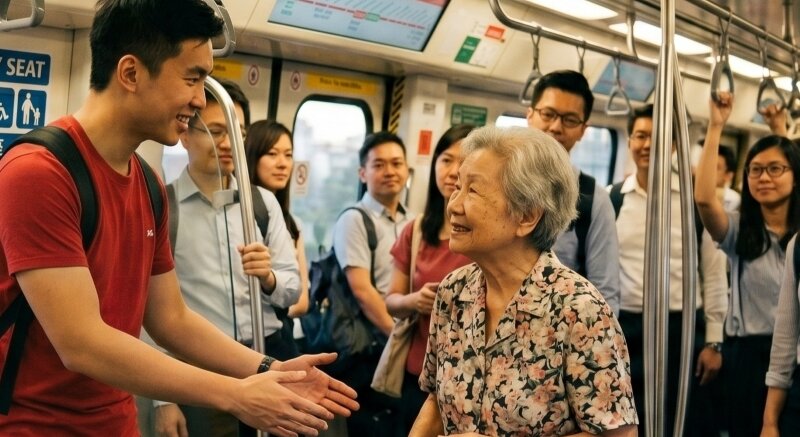
A secondary school student seated on a yellow priority seat while an elderly woman with a walking stick stands nearby
An orderly single-file queue at a covered HDB bus stop, with two children chatting loudly and stepping out of line
MRT platform doors opening with floor arrows for “Board here” and “Alight here”
A bus kneeling at a stop so a senior with a pram or wheelchair can board
C. Possible PSLE Oral Question Angles
How might the elderly woman in the photograph be feeling? Why?
Have you ever given up your seat on the MRT or bus? Tell us about it.
Do you think young people in Singapore are considerate enough on public transport?
Why is it important to let passengers alight before boarding?
D. Simple Speaking Points for Students
Point 1: Yellow priority seats are not always empty. The rule is “sit respectfully, give up gracefully”. A student may sit on a yellow seat when the carriage is quiet, then give it up as soon as someone who needs it more steps on. This is a more accurate answer than “we cannot sit on yellow seats”, which many students mistakenly give.
Point 2: Moving in matters more than people think. When commuters near the doors do not move further into the carriage, passengers behind them cannot board. Move-In Martin is the LTA mascot for this exact habit, and naming him in an answer always lands well.
Point 3: Small actions add up. Letting an alighting passenger exit first, keeping a bag on your lap or on the floor instead of the next seat, and using earphones when watching a video are all things a Primary 6 student can do on their own.
E. Useful Vocabulary and Phrases
give up my seat
a priority seat
let passengers alight first
move into the carriage
queue in single file
keep my bag off the seat
be a considerate commuter
use earphones in public
show graciousness on the MRT
the Thoughtful Bunch
F. Sample Answer Starter
“Yes, I have given up my seat on the MRT before. I once sat on a yellow priority seat when the train was almost empty, and when an elderly uncle with a walking stick boarded at the next station, I stood up so he could sit. He smiled and thanked me, and I felt good about the small action.”
Closer to exam season, our exam-prep guide for PSLE oral walks parents through the final two weeks.
Theme 3 – Being Considerate in Public Places
A. What This Theme Is About
Considerate behaviour in public places covers the everyday situations a Primary 6 student moves through: hawker centres, libraries, lifts, escalators and HDB common corridors. The biggest change in recent years has been the mandatory tray return rule at hawker centres and food courts, which has lifted the return rate from 65 per cent in 2021 to about 93 per cent today. The Singapore Kindness Movement’s mascot Singa the Lion has been promoting these habits since 1982, and Kindness Day SG is marked every May in primary schools across the island.
B. What Students May See in a Photo Stimulus
Realistic scenes include:
A teenager carrying a loaded tray to a hawker centre return station while an older diner walks away from an uncleared table
A group of students at a public library, one talking on the phone with an earpiece and another eating discreetly
A primary school student holding the lift door open for an elderly resident with grocery bags
A queue at a kopitiam where someone has placed a tissue packet on a seat to “chope” it
C. Possible PSLE Oral Question Angles
What is the student in the photograph doing? How might the elderly resident be feeling?
Tell us about a time when you helped someone in your neighbourhood.
Why is it important to follow rules in shared public spaces like a library?
Do you think the mandatory tray return rule has changed the way Singaporeans behave?
D. Simple Speaking Points for Students
Point 1: Considerate behaviour starts with noticing other people. A student who pays attention sees who is struggling with bags at the lift, who is reading quietly at the next library table, and who might appreciate a held door. The action follows from the noticing.
Point 2: Tray return is the most visible recent shift in Singapore’s public behaviour. NEA’s data shows the return rate has climbed from 65 per cent in 2021 to about 93 per cent today. A student who returns their tray every time, and who explains that this makes the cleaner uncle’s day easier, sounds aware and grounded.
Point 3: The library has its own rules and its own atmosphere. NLB’s etiquette is simple: speak softly, silence the phone, eat only in designated areas. Students who use the library regularly can describe what they do differently there compared to home.
E. Useful Vocabulary and Phrases
return our trays
keep our voices down
be considerate to others
hold the lift door
give way at the escalator
show kindness in small ways
respect shared spaces
be a good neighbour
do my part for the community
small actions, big difference
F. Sample Answer Starter
“Yes, I think the mandatory tray return rule has changed how Singaporeans behave at hawker centres. Before the rule, my family sometimes left our trays on the table without thinking. Now we always return them, and I have noticed that almost everyone around us does the same. It has become a normal habit.”
For more practice prompts, our page of past PSLE oral questions is the closest thing to a real warm-up.
A Practice Table for Parents at Home
The most useful thing you can do this week is sit with your child for 15 minutes and walk through one of the prompts below. Aim for a back-and-forth conversation. Skip the recitation drill.
Theme A – Road Safety
→ Ask Your Child: “Why is it dangerous to use your phone while crossing the road?”→ A Good Example to Use: “I once almost stepped onto the road while looking at a notification, and my mother pulled me back.”→ Useful Phrase: stay alert at all times→ What Parents Should Listen For: Does the child give a real example, not just a rule?
Theme B – Public Transport Etiquette
→ Ask Your Child: “Do you think young people in Singapore are considerate enough on the MRT?”→ A Good Example to Use: “I gave up my yellow priority seat for an elderly uncle last week, and he smiled at me.”→ Useful Phrase: sit respectfully, give up gracefully→ What Parents Should Listen For: Does the child explain the priority-seat rule correctly?
Theme C – Considerate in Public
→ Ask Your Child: “Has the mandatory tray return rule changed Singaporeans?”→ A Good Example to Use: “My family used to leave trays on the table; now we always return them.”→ Useful Phrase: do my part for the community→ What Parents Should Listen For: Does the child describe a real change in habit, not just describe the rule?
Use one row per night across a school week. By the weekend, your child has practised all three themes with a real audience.
How to Answer PSLE Oral Questions Better
Most strong SBC answers follow a simple, repeatable shape. Teach your child this five-step structure and they will sound clear and confident in any direction the conversation moves.
Answer the question directly. (“Yes, I think the mandatory tray return rule has changed Singaporeans.”)
Give a reason. (“…because it made considerate behaviour visible to everyone in the hawker centre.”)
Add an example. (“Before the rule, my family used to leave our trays. Now we return them every time.”)
Explain why it matters. (“…and almost everyone around us does the same, which makes the cleaner uncle’s work easier.”)
End naturally. (“That is why I think the rule has worked.”)
This is the same answer shape we coach in our oral classes at WRITERS AT WORK. It gives the examiner everything they are looking for in the SBC rubric: a clear opinion supported by personal example and a real reason. For more strategies, our piece on powerful PSLE oral tips is worth a read.
Common Mistakes Primary 6 Students Make
Even children who know the topic well lose marks for predictable reasons:
Confusing what they “should” do with what they actually do. “I always wait for the green man, and I always return my tray” sounds rehearsed. A small honest moment (“I used to scroll while walking, but I stopped after my mum pointed it out”) sounds real.
Over-explaining the rule and forgetting the personal. “Tray return is mandatory in Singapore because NEA wants to keep hawker centres clean” is civic education class. The examiner is looking for what the child does and why.
Generic “Singapore is safe” platitudes on road safety. Better to describe something the child has actually seen near their own school or estate.
Not knowing what “priority seat” really means. Saying “old people should get those seats” is vague. Better to name the yellow seat correctly and explain “sit respectfully, give up gracefully”.
Mixing up Mr Zebra (the road safety mascot) with the Thoughtful Bunch (the LTA public transport mascots). They belong to different campaigns.
Defaulting to anti-littering for every “considerate in public” question. A wider repertoire (tray return, library volume, holding the lift, queueing) shows genuine understanding. Our post on boosting speaking confidence covers delivery in more depth.
Mini Practice Section
Two photo-stimulus practice scenes to try this week:
A pair of primary school students at a zebra crossing during morning drop-off. The green man is showing. One student is looking down at a phone; the other holds a “STOP” placard at arm’s length to alert an approaching car. A parent stands a step behind them.
An MRT carriage at peak hour. A secondary school student sits on a yellow priority seat with a phone in hand. An elderly woman with a walking stick stands nearby, glancing at the seat. Other commuters look at the student.
Discussion questions to ask after each scene:
What do you think is happening in the photograph? How do the people seem to feel?
Have you done something similar yourself, or seen this happen near you? Tell us about it.
Do you think this is something children should pay more attention to? Why?
A checklist your child can run through before answering:
Did I answer the question directly?
Did I give a reason?
Did I give a personal example?
Did I explain why it matters?
Did I use at least one good phrase?
Closer to exam season, our exam-prep guide for PSLE oral walks parents through the final two weeks.
Strengthening Oral with WRITERS AT WORK
PSLE Oral preparation rewards consistency more than cleverness. A child who has practised the same answer structure on a dozen everyday topics with a real listener walks into the examination room knowing what to do.
At WRITERS AT WORK, our Primary 5 and Primary 6 English programmes give students that listener in classes where every child speaks and gets feedback. The same disciplined approach that powers our composition work through STORYBANKING® shapes how we coach oral: clear ideas, organised into confident and audible responses. We help students observe carefully and express opinions in a way that sounds natural rather than rehearsed.
If you would like your child to practise oral with structure every week, get in touch through our website. Follow us on Instagram, Facebook and YouTube for weekly tips.
Frequently Asked Questions
My child says vague things like "we should be considerate." How do I get more specific answers?
Push gently for the example. Ask “Can you think of a time you did that?” or “Can you tell me about someone you saw doing that?” The shift from a rule (“we should be considerate”) to a specific moment (“I held the lift for an auntie with grocery bags last Tuesday”) is the single biggest jump in oral quality for this topic.
Are the LTA Thoughtful Bunch characters really worth memorising?
Naming one or two of them lands well. The examiner sees that the child is paying attention to the world around them. Stand-Up Stacey and Move-In Martin are the most useful pair to remember because they cover the two most common etiquette moments on the MRT.
My child is shy on public transport. Does that affect their answer?
Not directly. The examiner cannot see your child on the MRT. What matters is whether your child can describe a real moment, including a small one. “I have not always given up my seat, but I noticed an aunty needed mine on the bus last week, and I stood up for her” is a perfectly strong answer.
Should my child memorise statistics like the tray return rate?
One memorable number can lift an answer, but more than that becomes recitation. The 65 per cent to 93 per cent jump in tray return is worth remembering because it tells a small story (a rule worked). The annual road traffic numbers are less useful for a Primary 6 oral answer because they pull the conversation away from personal experience.

Article Written By
Agnes Ng
Agnes Ng, Co-Founder and Teaching & Curriculum Director of WRITERS AT WORK. An NUS Honours graduate and published author with over 30 years of experience, Agnes has been the architect of the organization’s student-centric curricula since 2012.
Dedicated to teacher mentorship and academic excellence, she has guided hundreds of students to achieve outstanding results. Her expertise and commitment to high-quality education remain the cornerstone of WRITERS AT WORK’s success in empowering every learner.