- Jul 31
PSLE Oral Topics: Healthy Lifestyle & Food Choices
- Jemmies Siew
Healthy lifestyle is one of the most familiar conversation topics in the PSLE Oral examination, and one of the easiest for parents to help with at home. Food choices, exercise, sleep, screen time and daily habits are all part of a Primary 6 student’s everyday life. That is precisely why the Stimulus-Based Conversation (SBC) section often draws from this territory. The examiner is looking for natural, confident speech grounded in real experience. Memorised paragraphs land flat.
From the 2025 sitting onward, the PSLE Oral is worth 40 marks (20 per cent of the overall English grade), with 25 of those marks allocated to the SBC. The stimulus is now a real-life photograph, and your child will be asked three questions: one anchored in the photograph, and two broader questions on personal experience and opinion. You can read more in our guide to the 2025 oral changes.
This post breaks the topic into three themes, each with talking points, vocabulary, sample answer starters and a practice table you can use at home tonight.
Why This Topic Matters for PSLE Oral
The SBC rewards children who can observe a photograph carefully, share a personal experience and give a clear opinion. Healthy lifestyle questions invite all of these. A child who has practised this topic well can describe what is happening in a canteen scene and explain why eating well matters to them, with a personal example to back it up.
SEAB has stated that oral topics reflect the “common occurrences that students experience in daily life”. Food, school recess, CCAs, hobbies and family routines all sit squarely inside that brief. Past PSLE oral questions in circulation have asked students how they keep fit, whether sleep is important to them, and what their favourite food is. None of that is a prediction. It tells you what kind of speaking practice is well-spent time.
For more topic ideas across the syllabus, see our PSLE Oral Topics 2025 Guide.
The Three Themes Covered in This Blog
Three connected themes give your child a different angle for each question:
Healthy Eating
Exercise and Active Living
Good Daily Habits: Sleep and Screen-Time Balance
Each theme below uses the same structure: what it covers, possible photo stimuli, likely question angles, three speaking points, useful vocabulary and a sample answer starter.
Theme 1 – Healthy Eating
A. What This Theme Is About
Healthy eating is about making better food choices most days: more fruit and vegetables, wholegrains like brown rice or wholemeal bread, lean protein, and plain water instead of sweet drinks. The Health Promotion Board’s My Healthy Plate puts it simply. Half the plate should be fruit and vegetables. The other half is split between wholegrains and lean meat or alternatives.
B. What Students May See in a Photo Stimulus
Realistic scenes include:
A student at the school canteen choosing brown rice with extra vegetables at the cai png stall
A family at a hawker centre, with one child holding a cup of plain water
A parent and child preparing fruit at home, with school bags by the door
A canteen vendor scooping vegetables onto a compartmentalised tray
The photograph is the springboard for the first question. Your child needs to describe what they actually see before drifting into personal opinion.
C. Possible PSLE Oral Question Angles
Q1 asks the child to observe and infer; Q2 and Q3 broaden out. Examples:
What do you think the people in the photograph are doing? How do they seem to feel?
Do you enjoy eating at your school canteen? Tell us about what you usually have.
Do you think it is important for children to eat healthily? Why?
Is it easy to eat healthily in Singapore?
D. Simple Speaking Points for Students
Point 1: Healthy food helps children focus in class. When students eat a balanced lunch, they feel less sluggish in the afternoon. For example, choosing brown rice with extra vegetables at recess gives steadier energy for the next lesson.
Point 2: Singapore makes it easier to choose well. The Healthier Choice Symbol (HCS) appears on packaged drinks in school vending machines and on healthier dishes at some hawker stalls. Students can look for the green logo when they are unsure.
Point 3: Small swaps add up. Swapping a sweet drink for plain water at one meal, or asking for extra vegetables at the cai png stall, are simple changes a Primary 6 student can make on their own.
E. Useful Vocabulary and Phrases
nutritious food
balanced meal
brown rice and wholegrains
the Healthier Choice Symbol
plain water
lean protein
eat in moderation
fuel for the body
make better choices
stay focused in class
F. Sample Answer Starter
“Yes, I think it is important for children to eat healthily because it helps us stay focused in school. For example, when I choose brown rice with vegetables at the canteen, I feel less tired in the afternoon than when I have something fried.”
Keep the starter short. The examiner will follow up. For more, see our piece on the essentials of healthy eating.
Theme 2 – Exercise and Active Living
A. What This Theme Is About
The Singapore Integrated 24-Hour Activity Guidelines recommend at least 60 minutes of moderate-to-vigorous activity every day for children aged 7 to 17. That can be built up in short bouts: a 15-minute walk to the MRT, a CCA session after school, a Sunday cycle on the park connector.
B. What Students May See in a Photo Stimulus
Realistic scenes include:
A group of students playing basketball at the school court during recess
Children swimming at an ActiveSG complex while a parent watches from the poolside
A family cycling along a tree-lined park connector on a Sunday morning
Children playing at a three-generation fitness corner near an HDB block
C. Possible PSLE Oral Question Angles
What activities do the people in the photograph seem to enjoy? How do they feel?
What do you like to do during recess or after school? Tell us more.
Do you think it is important for children to be physically active? Why?
Does Singapore provide enough places for children to exercise?
D. Simple Speaking Points for Students
Point 1: Exercise does not always mean formal sport. PE lessons and CCAs count, but plenty of other activities do too: a swim at the ActiveSG pool, a Sunday cycle along the park connector, even an evening of football at the void deck. Children who only think of sport as “CCA” often miss the bigger picture.
Point 2: Active habits protect against tiredness and stress. Students who move regularly tend to sleep better and concentrate longer, especially during exam periods. Even 20 minutes after dinner makes a difference.
Point 3: Singapore is built for active living. Park connectors link estates across the island, and most HDB estates have a playground and a fitness corner within walking distance. ActiveSG facilities are easily reached by MRT.
E. Useful Vocabulary and Phrases
active lifestyle
moderate-to-vigorous activity
park connectors
CCA (co-curricular activity)
play badminton or basketball
take part in PE lessons
swim at the ActiveSG complex
build stamina
burn off energy
stay fit and healthy
F. Sample Answer Starter
“I think it is important for children to be physically active because exercise keeps us healthy and helps us focus better in class. For example, I cycle along the park connector with my family on Sunday mornings, and I always feel more awake on Monday.”
You can read more about how staying active during the exam season actually helps grades in our post on the 5 benefits of staying active during exam prep .
Theme 3 – Good Daily Habits: Sleep and Screen Time
A. What This Theme Is About
Sleep and screen time are the two daily habits that most affect a Primary 6 student’s focus and mood. The Singapore 24-Hour Activity Guidelines recommend at least 9 hours of sleep per night for children aged 7 to 13. The updated Grow Well SG screen use guidelines, launched in January 2025, recommend less than 2 hours of recreational screen time per day for primary-school children, with no screens during meals or in the hour before bed.
B. What Students May See in a Photo Stimulus
Realistic scenes include:
A student studying at a desk with a phone placed face-down on a shelf behind
A child reading a book in bed while a parent dims the lamp
A family at dinner with no devices on the table
A sibling pair playing a board game in the living room rather than scrolling
C. Possible PSLE Oral Question Angles
What do you think the student is doing in the photograph? Why?
How do you usually manage your screen time on school nights?
Do you think it is difficult for students to limit their use of devices? Why?
Why do you think sleep is important for students?
D. Simple Speaking Points for Students
Point 1: Sleep is the easiest grade booster most students ignore. The Ministry of Education’s 2023 survey found that P5 students averaged only 7 hours of sleep on school nights, which is two hours short of what is recommended. A child who sleeps an hour earlier often does better in school the next day.
Point 2: Screen time has a useful side and a tempting side. Devices help with learning on the Student Learning Space (SLS). The pull to game or scroll after homework eats into bedtime. Putting the phone in a different room after 8:30pm works better than relying on willpower.
Point 3: Habits are easier to keep when the family does them together. A 9pm device-free hour or a no-phones-at-dinner rule is easier to follow when parents do the same, and students who can describe a real family habit sound authentic to the examiner.
E. Useful Vocabulary and Phrases
a consistent bedtime routine
unwind before bed
limit recreational screen time
devices have their place
put the phone away
a good night’s sleep
feel refreshed in the morning
manage time wisely
set healthy limits
recharge for the next day
F. Sample Answer Starter
“Yes, I think sleep is very important for students because it affects how well we focus the next day. For example, when I sleep by 9:30pm, I find it much easier to concentrate during lessons. When I sleep late after using my phone, I make more careless mistakes.”
For practical strategies on both sides, our posts on the sleep-success connection and healthy screen-time habits give parents a starting framework.
A Practice Table for Parents at Home
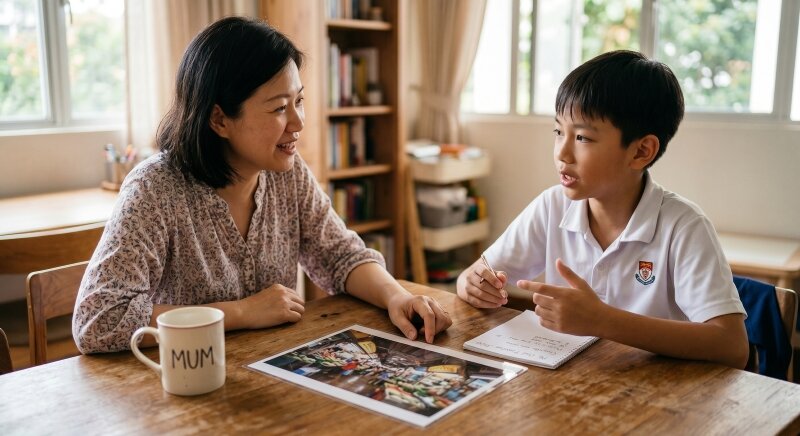
The most useful thing you can do this week is sit with your child for 15 minutes and walk through one of the prompts below. Aim for a back-and-forth conversation. Skip the recitation drill.
Theme A – Healthy Eating
→ Ask Your Child: “Why is it important to eat well as a student?”→ A Good Example to Use: “I choose brown rice and vegetables at the cai png stall instead of fried food.”→ Useful Phrase: a balanced meal→ What Parents Should Listen For: Does the child give a reason and a personal example?
Theme B – Exercise
→ Ask Your Child: “Why is regular exercise good for children?”→ A Good Example to Use: “I cycle along the park connector with my family on Sundays.”→ Useful Phrase: an active lifestyle→ What Parents Should Listen For: Does the child explain why exercise matters, rather than only what they do?
Theme C – Sleep and Screens
→ Ask Your Child: “Why is sleep important for school?”→ A Good Example to Use: “When I sleep by 9:30pm, I focus better the next morning.”→ Useful Phrase: a consistent bedtime→ What Parents Should Listen For: Does the child connect the habit to a real result?
Use one row per night across a school week. By the weekend, your child has practised all three themes with a real audience.
How to Answer PSLE Oral Questions Better
Most strong SBC answers follow a simple, repeatable shape. Teach your child this five-step structure and they will sound clear and confident in any direction the conversation moves.
Answer the question directly. (“Yes, I think it is important to eat healthily.”)
Give a reason. (“…because it helps us focus better in class.”)
Add an example. (“For example, when I choose brown rice and vegetables at the canteen…”)
Explain why it matters. (“…I feel less tired in the afternoon and I make fewer mistakes.”)
End naturally. (“That is why I try to make better choices when I can.”)
This is the same answer shape we coach in our oral classes at WRITERS AT WORK. It gives the examiner everything they are looking for in the SBC rubric: clear opinion, supported reasoning, personal connection, and confident delivery. For more strategies, our piece on powerful PSLE oral tips is worth a read.
Common Mistakes Primary 6 Students Make
Even children who know the topic well lose marks for predictable reasons:
Giving one-line answers and stopping. “Yes, exercise is important.” Full stop. The examiner needs more to award marks.
Describing the photograph in detail without inferring anything. The 2025 format specifically asks how the people might be feeling and why.
Reciting a memorised paragraph regardless of the question. Children sometimes deliver the same “healthy lifestyle” speech whether the question is about food, exercise or sleep.
Sounding preachy. “Healthy eating prevents chronic disease” reads like a poster. A personal example lands better.
Using overly complex vocabulary. Words like “cardiovascular” or “metabolism” tend to sound forced. Clear, accurate English is more impressive.
Speaking too softly or rushing. Voice projection and pacing carry real marks. Our post on boosting speaking confidence covers this in detail.
Mini Practice Section
Two photo-stimulus practice scenes to try this week:
A student in front of two canteen stalls at recess: one selling fried chicken with white rice, the other a cai png stall with brown rice, vegetables and steamed chicken. The student is holding a coin and choosing.
A family cycling along a park connector on a Sunday morning. The older child leads the group. A water bottle is clipped to the bicycle.
Discussion questions to ask after each scene:
What do you think is happening in the photograph? How do the people seem to feel?
Have you done something similar yourself? Tell us about it.
Do you think this is something children should try to do? Why?
A checklist your child can run through before answering:
Did I answer the question directly?
Did I give a reason?
Did I give a personal example?
Did I explain why it matters?
Did I use at least one good phrase?
For more practice prompts, our page of past PSLE oral questions is the closest thing to a real warm-up. Closer to exam season, our exam-prep guide for PSLE oral walks parents through the final two weeks.
Strengthening Oral with WRITERS AT WORK
PSLE Oral preparation rewards consistency more than cleverness. A child who has practised the same answer structure on a dozen everyday topics with a real listener walks into the examination room knowing what to do.
At WRITERS AT WORK, our Primary 5 and Primary 6 English programmes give students that listener in classes where every child speaks and gets feedback. The same disciplined approach that powers our composition work through STORYBANKING® shapes how we coach oral: clear ideas, organised into confident and audible responses. We help students observe carefully and express opinions in a way that sounds natural rather than rehearsed.
If you would like your child to practise oral with structure every week, get in touch through our website. Follow us on Instagram , Facebook and YouTube for weekly tips.
Frequently Asked Questions
My child is shy. How do I get them to practise oral at home?
Start small. Sit beside them and use a real photograph from your camera roll as the stimulus. Treat it as a chat, not a test. Ten minutes after dinner three times a week is more useful than a one-hour session on Sunday. Praise the specific things your child did well so they know what to repeat.
How long should a PSLE oral answer be?
A strong SBC answer is usually three to five sentences for the first question and slightly longer for the follow-ups. The five-step shape above lands at roughly the right length. Going on too long often causes a student to lose focus; stopping after one line gives the examiner nothing to mark.
Should my child memorise model answers for healthy lifestyle?
Memorising a single paragraph is risky. The 2025 SBC format rewards responsiveness, and an examiner can tell when a child is reciting. A better approach is to memorise the answer structure and a handful of strong phrases per theme, then build the answer on the spot from a real personal example.
How can I tell if my child is improving at oral?
Three signs are reliable. First, they answer the question directly without warming up with filler. Second, they give a personal example without being prompted. Third, they sound natural rather than performed. Record one practice answer each week and the difference becomes obvious by month’s end.

Article Written By
Agnes Ng
Agnes Ng, Co-Founder and Teaching & Curriculum Director of WRITERS AT WORK. An NUS Honours graduate and published author with over 30 years of experience, Agnes has been the architect of the organization’s student-centric curricula since 2012.
Dedicated to teacher mentorship and academic excellence, she has guided hundreds of students to achieve outstanding results. Her expertise and commitment to high-quality education remain the cornerstone of WRITERS AT WORK’s success in empowering every learner.